Tadhg Gaelach Ó Súilleabháin (Baile Uí Fhlaithnín, Port Láirge)
Tadhg Gaelach Ó Suilleabháin, poet and teacher, is said to have died while praying in the Cathedral, Waterford, on 22 April 1795; he was the author of a best-selling collection of religious verse in Irish, Timothy O’Sullivan’s Pious Miscellany, first published in Clonmel in 1802. He was buried in the old graveyard in Ballylaneen, co. Waterford.
Local tradition (see Máire B. de Paor, Tadhg Gaelach Ó Suillebháin: File agus Diagaire, Muine Bheag, 2005, p. 426) records that a local man returned from America and was surprised to find that the grave of such a well known poet was unmarked; he then commissioned a local blacksmith, Aindiras Ó Sceacháin, to make a Celtic cross in iron to mark the grave.
The one-hundredth anniversary of another Waterford poet, Donnchadh Rua Mac Conmara, author of Eachtra Ghiolla an Amaráin, fell on 6 October 1910. The occasion prompted a campaign led by Fr Patrick Power, organised through the journal of the Waterford and South-East of Ireland Archaeological Society (of which he was editor) and Conradh na Gaeilge, to commemorate both Mac Conmara (buried at Newtown, near Kilmacthomas) and Ó Suilleabháin. The result of this campaign, which initially struggled to raise the required funds from subscribers, was two new headstones, one in Ballylaneen for Ó Suilleabháin and one in Newtown for Mac Conmara. A further campaign was successfully organised to commemorate Geoffrey Keating in the same way, at Tubbrid in Tipperary.
The headstone for Ó Suilleabháin was inscribed by Liam Ó Míocháin of An Rinn with a Latin epigraph written by Mac Conmara to commemorate his deceased friend. This poem was printed and translated into Irish several times between 1849 and 1924; it is first found in a manuscript of Mac Conmara’s poetry copied in the 1820s and now held at the John Rylands Library at the University of Manchester. The Latin poem features themes traditionally found in Latin epitaphs (elegiac metre, the appeal to the passer-by to stop and read, the invocation of the Muses, the deceased person becoming a star) mixed with religious imagery and a reference to Eochaid Mugmedón, father of Niall of the Nine Hostages. There are two textual variants in the Latin: e terra for atque volans and angelus for fervidus.
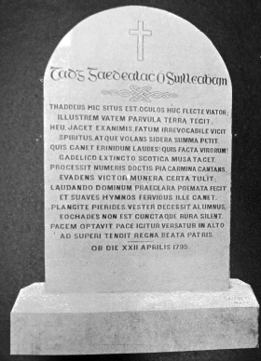
The new headstone photographed in 1910 (Journal of the Waterford and South-East of Ireland Archæological Society, ed. Patrick Power, First Quarter, January to March 1911. Plate, ‘Memorial to Tadhg Gaedhealach, Ballylaneen Graveyard. (Erected December, 1910)’ – between pages 44 and 45.
Tadhg Gaelach Ó Suilleabháin
THADDEUS HIC SITUS EST: OCULOS HUC FLECTE VIATOR;
ILLUSTREM VATEM PARVULA TERRA TEGIT;
HEU, JACET EXANIMIS, FATUM IRREVOCABILE VICIT
SPIRITUS ATQUE VOLANS SIDERA SUMMA PETIT.
QUIS CANET ERINIDUM LAUDES? QUIS FACTA VIRORUM?
GADELICO EXTINCTO SCOTICA MUSA TACET.
PROCESSIT NUMERIS DOCTIS PIA CARMINA CANTANS,
EVADENS VICTOR MUNERA CERTA TULIT;
LAUDANDO DOMINUM PRAECLARA POEMATA FECIT
ET SUAVES HYMNOS FERVIDUS ILLE CANET.
PLANGITE PIERIDES, VESTER DECESSIT ALUMNUS,
EOCHADES NON EST CUNCTAQUE RURA SILENT.
PACEM OPTAVIT PACE IGITUR VERSATUR IN ALTO
AD SUPERI TENDIT REGNA BEATA PATRIS.
OB[IT] DIE XXII APRILIS 1795.
An Irish translation by local teacher Tomás Breathnach (Thomas Walsh) was inscribed on a marble plaque and placed at the foot of the headstone.
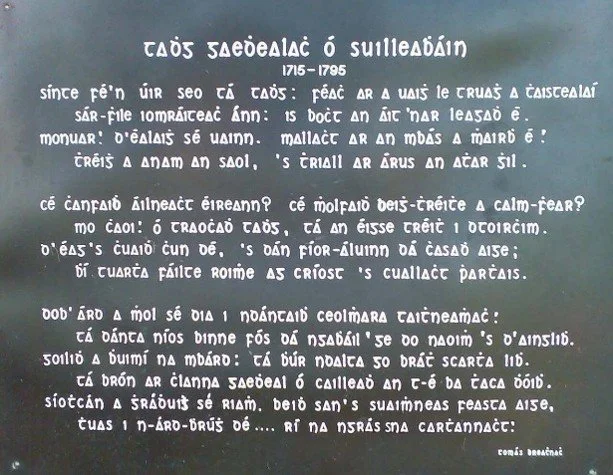
Author’s photograph (2022)
Tomás Breathnach’s Irish translation (any corrections to my transcription of the cló Gaelach gratefully received):
Sínte faoin úir seo tá Tadhg: féach ar a uaigh le trua, a thaistealaí,
Sár-fhile iomráiteach ánn: is bocht an áit ‘nar leagagh é.
Monuar! D’ealaigh sé uainn. Mallacht ar an mbás a mhairbh é!
Thréigh a anam an saol, agus thriall ar árus athair ghil.
Cé chanfaidh áilneacht Éireann? Cé mholfiadh deigh-thréithe a calm-fhear?
Mo chaoi! Ó traochadh Tadhg, tá an éigse tréith i dtoirchim.
D’éag ‘s chuaidh chun Dé, ‘s dán fíor-áluinn dá chasadh aige;
Bhí tuartha fáílte roimhe ag Críost ‘s cuallacht pharthais.
Dob’árd a mhol sé Dia i ndántaibh ceolmhara taithneamhach!
Tá dánta níos binne fós da ngabháil aige do naoimh s’ d’ainglibh.
Goilidh a bhuimí na bárd: tá bhúr ndalta go bráth scartha libh.
Tá brón ar chlanna Gaedhael ó cailleadh an t-é ba thaca dóibh.
Siochán a ghráuig sé riamh. Beidh san ‘s suimhneas feasta aige,
thuas i n-árd-bhúgh Dé … Rí na ngrás sna carthannacht!
English translation (CK):
Here lies Tadhg – look this way, traveller,
A little earth covers a famous poet.
Alas, dead he lies, unswerving Fate has won;
His soaring spirit seeks the lofty stars.
Who will sing the praises of the Irish, the deeds of its heroes?
With Gaelach gone, the Irish Muse is silent.
Singing holy songs in learned measures he has passed on;
Victorious now, he has received his sure reward.
By praising God he made beautiful poems,
And now he will sing sweet hymns with gusto.
Weep, ye Muses: your adoptive son is no more,
Eochadh’s descendant is no longer, and all the fields are quiet.
He hoped for peace, so let him rest in peace eternally;
He reaches now the blessed kingdoms of our heavenly Father.
Died 22 April 1795.