Charles Le Poer Trench (Ballinasloe)
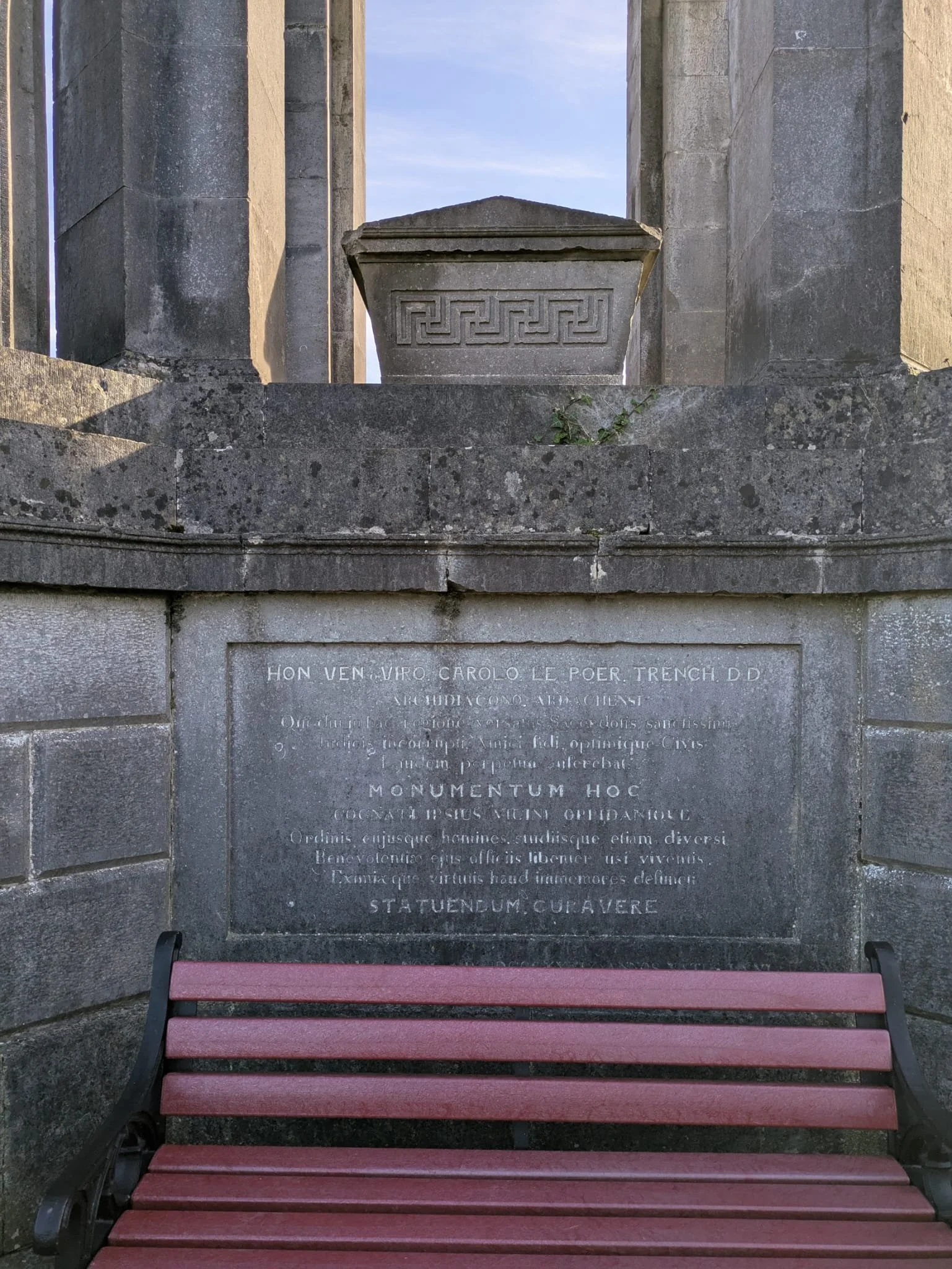
HON VEN VIRO CAROLO LE POER TRENCH DD
ARCHIDIACONO ARDACHENSI
Qui diu in hac regione versatus Sacerdotis sanctissimi
Iudicis incorrupti Amici fidi optimi Civis
Laudem perpetuam auferebat.
MONUMENTUM HOC
COGNATI IPSIUS VICINI OPPIDANIQUE
Ordinis cuiusque homines studiisque etiam diversi
Benevolentiae ejus officiis libenter usi viventis
Eximiaeque virtutis haud immemores defuncti
STATUENDUM CURAVERE
‘This monument was erected by subscribers of all classes and religious distinctions in grateful remembrance of the active benevolence, unwearied kindness, unaffected piety, and the many other virtues manifested by the Hon. and Ven. Charles Le Poer Trench D.D., Archdeacon of Ardagh, who lived for many years amongst them, spending and being spent for the glory of God and the good of his fellow-men, and died on the 31st day of October A.D. 1839, aged 66 years.’
The memorial’s English inscription (not pictured) is taken from Lally 2021.
This ‘fine Greek revival memorial’ (Williams 1994, 265) was built in 1840, to a design by the architect George Papworth, to commemorate Charles le Poer Trench (1772-1839), a member of the Clancarty/Le Poer Trench families, French Hugenot in origin and landowners in co. Galway. Their seat was Garbally House.
The bilingualism of the inscription in English and Latin is interesting; the former was presumably meant to ensure the memorial could be read, the latter to adopt of the forms of classical Latin elegy to commemorate a member of the community (Trench himself was reported to have been fluent in Irish, which does not appear). Trench was an active but controversial figure in the community (see Lally; Smith, 63-74), who died of typhus fever, which ‘he caught … during his spiritual vocation, while attending at the sick bed of one of his poor parishioners’ (Obituary, Leinster Express, 1839).
Though placed in a prominent position on the Market Green and overlooking the old Dublin-Galway road, and despite its English inscription, in subsequent years the purpose of the memorial and its inscriptions appear to have been little known: Lally 2021 refers to a local story that the monument was built as a tomb for one the Earl’s hunting dogs.
See further:
Barry Lally, ‘Archdeacon Charles Trench’, Ballinasloe Life, vol. 11 no. 1, April-May 2021, 56-8, available online.
Rod Smith, Clancarty: the high times and humble of a noble Irish family (Tauranga: Eyeglass Press, 2021).
Jeremy Williams, A Companion Guide to Architecture in Ireland, 1837-1921, Irish Academic Press, 1994).